Beef · Slow Cook · Hyderabadi

Pakistani Haleem — The 3-Hour Porridge Worth Every Minute

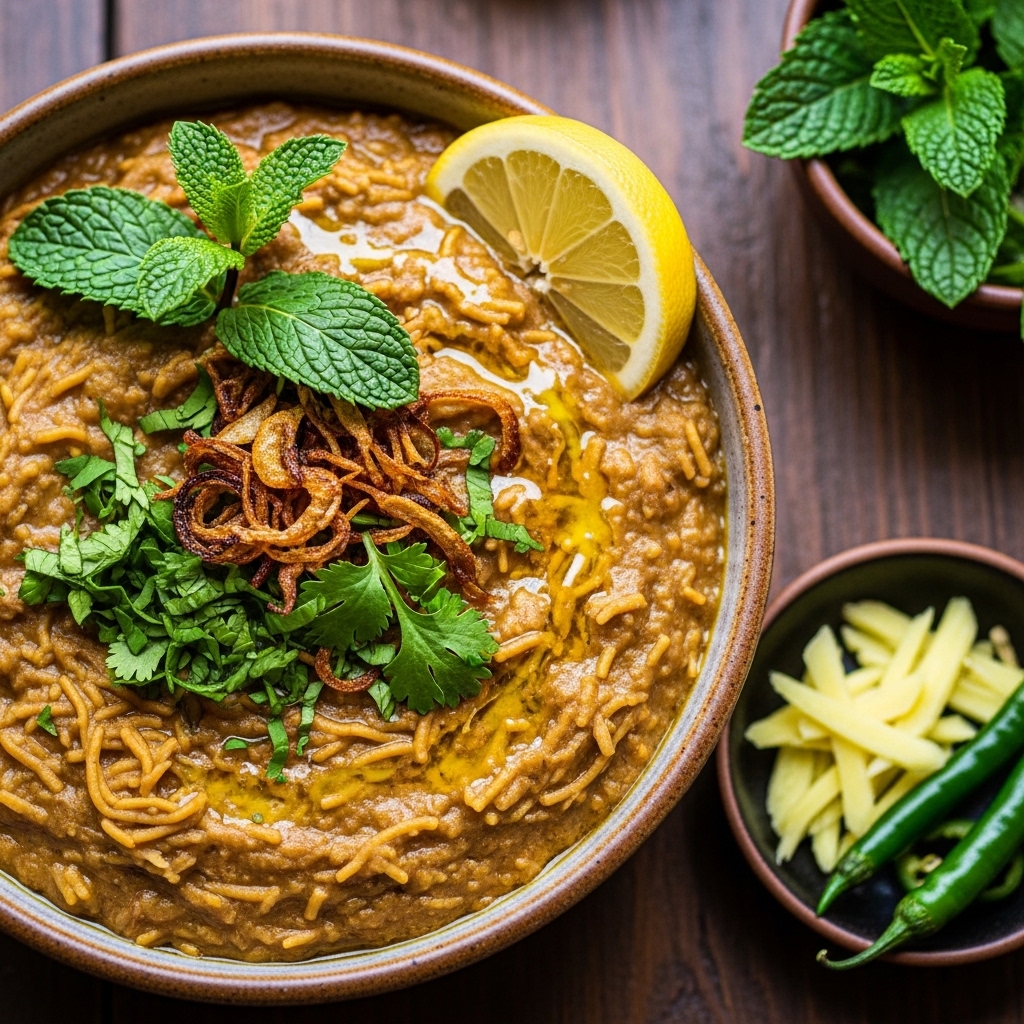
Cracked wheat, mixed lentils, and slow-braised beef pounded together into a thick, glossy porridge laced with ghee, crispy onions, and fresh ginger. Hyderabadi royalty, now in your kitchen.

Prep
45 min
Cook
3 hours
Serves
8
Difficulty
Hard
Origin
Hyderabad
Pakistani Haleem in a bowl
🥣

Haleem occupies a unique place in Pakistani food culture — it is simultaneously street food, wedding food, and comfort food. You'll find it sold from roadside pots in Karachi and served in silver bowls at Karachi weddings. Its origins trace to the Hyderabadi court, where it was known as harees, a slow-cooked wheat-and-meat dish that came to the subcontinent through Arab traders and was adopted and transformed by Mughal-era kitchens.

What makes haleem extraordinary is the texture — achieved through hours of slow cooking that breaks down both the grain and the meat into a unified mass, then vigorous stirring (or blending) to create a porridge that is simultaneously chunky and smooth. The toppings are not optional: crispy fried onions, fresh ginger julienne, green chillies, a squeeze of lemon, and a drizzle of ghee are as essential to the dish as the haleem itself.

This recipe serves 8 and scales well. It also freezes perfectly — make a large batch and freeze in portions for a weeknight meal that tastes like you cooked all weekend.


Ingredients

Grain & Lentil Mix (soak overnight)

Broken wheat (dalia)1 cup
Chana dal (split chickpea lentil)½ cup
Masoor dal (red lentil)¼ cup
Moong dal (yellow lentil)¼ cup
Urad dal (black lentil, skinned)2 tbsp

Meat & Base

Beef shank or shoulder, cubed700g
Onions, thinly sliced3 large
Ginger-garlic paste3 tbsp
Whole black cardamom2
Cinnamon sticks2
Cloves6
Bay leaves3
Red chilli powder2 tsp
Turmeric1 tsp
Coriander powder2 tsp
Garam masala1.5 tsp
Saltto taste
Oil or ghee5 tbsp
Water2–2.5 litres

Toppings (essential)

Fried onions (birista)1 cup
Fresh ginger, julienned4cm piece
Green chillies, sliced3–4
Fresh coriander, choppedlarge handful
Lemons, cut into wedges2
Ghee, to drizzle2 tbsp

Method

1

Soak the grains (the night before)

Combine all the dals and broken wheat in a large bowl. Cover with cold water and leave to soak for at least 8 hours. Soaking is non-negotiable — it dramatically reduces cooking time and ensures the grains cook evenly. In the morning, drain and rinse thoroughly.

2

Cook the grains separately

Place the soaked grains in a large pot with 1.5 litres of water and 1 tsp salt. Bring to a boil, skim off any foam, then reduce heat to low and simmer covered for 45 minutes until very soft and mushy. Set aside without draining — that starchy water is part of the dish.

3

Brown the onions and bloom the spices

Heat oil or ghee in a large heavy-bottomed pot over medium-high heat. Add sliced onions and fry for 18–22 minutes, stirring frequently, until they turn a deep mahogany brown. Reserve half for the topping (these become your fried onions). To the remaining onions in the pot, add the whole spices — cardamom, cinnamon, cloves, bay leaves — and stir for 1 minute. Add ginger-garlic paste and cook for 3 minutes until the raw smell disappears.

4

Brown the meat and add the masala

Add beef cubes to the pot and brown over high heat for 5–6 minutes, turning to colour on all sides. Add red chilli, turmeric, and coriander powder. Stir to coat. Add 500ml water, bring to boil, then reduce to low heat. Cover and cook for 1.5 to 2 hours until the meat is completely tender and falls apart when pressed.

⚡ The Shredding Test

The meat is ready when you can pull it apart with two forks with almost no resistance. Undercooked meat will make your haleem grainy. When in doubt, give it another 20 minutes.

5

Combine grains and meat — the long stir

Add the cooked grain mixture (with its water) to the meat pot. Stir vigorously to combine. The mixture will be very thick. Add up to 500ml more water to reach a thick porridge consistency. Cook over low heat, stirring every 5 minutes, for another 30–40 minutes. The constant stirring is what creates the smooth, unified texture of good haleem.

6

Blend (optional but recommended) and finish

For a smoother texture, use an immersion blender to partially blend the haleem — 4–5 short pulses is enough. You want some texture remaining, not a smooth soup. Add garam masala, taste for salt, and stir in 1 tbsp ghee. The final consistency should coat a spoon thickly and hold its shape when mounded in a bowl.

💡 Chef's Tip — The Topping Bar

Serve haleem family-style with a full topping bar: fried onions, ginger julienne, green chillies, fresh coriander, lemon wedges, and a pot of ghee. The contrast of the hot, rich haleem against the fresh, sharp toppings is what makes the dish complete.


Nutrition (per serving)

420
Calories
34g
Protein
38g
Carbs
16g
Fat